Why Posting Every Day is Actually Killing Your Channel (and What to Do Instead)
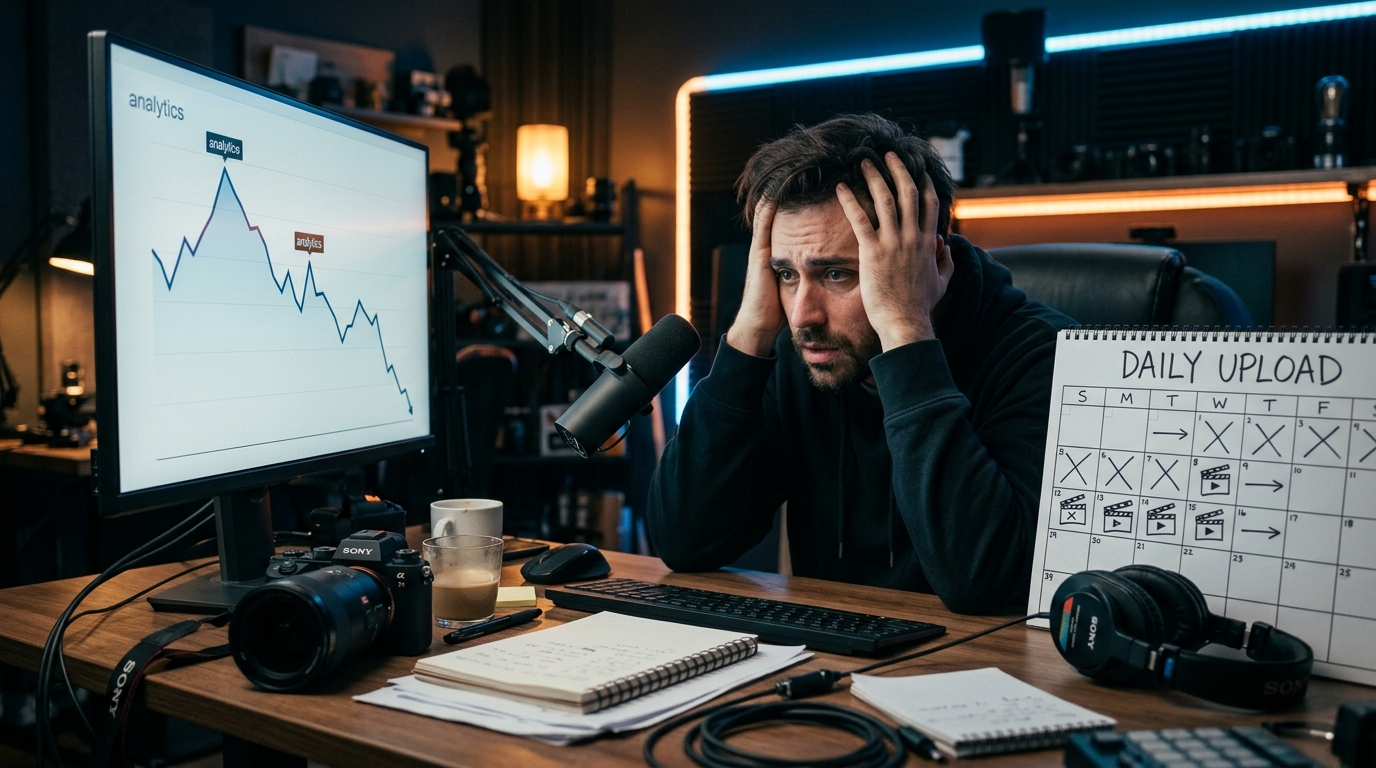
You are strangling your YouTube channel’s growth.
The "daily upload" myth is a relic from 2014 that is currently poisoning your reach.
If you are churning out one AI-generated track every 24 hours just to satisfy an imaginary quota, you are training the algorithm to ignore you.
I have seen talented producers burn out with 500 videos and zero subscribers because they prioritized the calendar over the listener.
Quantity without intent is just digital noise.
Every time you hit "publish" on a mediocre track, you tell YouTube’s recommendation engine that your content isn’t worth a long session.
You aren't building an audience; you are building a graveyard of unplayed audio files.
Insight📌 Key Takeaways:
- Algorithm Health: High-frequency posting of low-engagement content triggers a "spam" signal that suppresses your future reach.
- Retention Over Volume: A single high-quality track with stem-split precision outperforms seven days of "raw" AI exports.
- Predictable Rhythms: A successful youtube posting consistency strategy is about reliability, not frequency.
Why youtube posting consistency strategy is more important than ever right now
The bar for AI-generated music has moved from "novelty" to "professional grade" in less than six months.
Listeners no longer tolerate the "uncanny valley" of muddy Suno outputs or unmastered frequencies.
If you aren't using a youtube posting consistency strategy that focuses on high-retention tracks, you are leaving thousands in ad revenue on the table.
The algorithm has evolved from rewarding volume to rewarding audience satisfaction.
When a user skips your track in the first ten seconds because the mix is thin, YouTube notes that rejection.
A bad video doesn't just fail in a vacuum; it actively harms the "velocity" of your next upload.
This is where most SynthAudio users get it wrong during their first week.
They think automation means "more."
In reality, automation should mean "better."
You need to stop being a content factory and start acting like an AI-powered curator.
The current gold rush in Lo-Fi, Phonk, and ambient study music is massive, but it is a winner-takes-all game.
The channels that scale are those that define a rhythm, not a frequency.
Your youtube posting consistency strategy must be built on the expectation of quality.
If you use SynthAudio to generate 100 tracks, posting all 100 is channel suicide.
The winning move is picking the top 10, splitting the stems for a clean mix, and mastering them to professional standards.
Then, you post those 10 on a schedule that your audience can rely on.
Consistency means your fans know exactly when to show up and exactly what level of polish to expect.
When you break that trust with a rushed, daily upload, you lose a long-term subscriber for a short-term vanity stat.
The competition is using AI tools just like you are.
If your "AI music channel" sounds like a robot made it in five seconds, you will be crushed by the producers who use AI to enhance a human creative vision.
We are in the era of the Hybrid Producer.
The tools are here to handle the heavy lifting, but the youtube posting consistency strategy must remain human-centric.
If you don't treat your channel like a professional record label, the algorithm will treat you like a spam bot.
Stop racing against the clock and start racing against the quality of the top 1% in your niche.
Here is exactly how the "daily grind" is sabotaging your metrics—and how to pivot your workflow to save your channel.
Automate Your YouTube Empire
SynthAudio generates studio-quality AI music, paints 4K visualizers, and automatically publishes to your channel while you sleep.
The Algorithm’s Quality Trap
The most dangerous myth in the creator economy is that the YouTube algorithm "rewards" frequency above all else. While it is true that consistent data helps the platform categorize your content, the algorithm is ultimately a reflection of human behavior. When you force a daily schedule, the first thing to suffer is your Click-Through Rate (CTR) and Average View Duration (AVD).
If you are producing mediocre content just to meet a deadline, your audience will stop clicking. When the algorithm sees a drop in engagement, it stops pushing your videos to new viewers. This is especially prevalent in high-competition niches. For example, many creators believe that volume is the only way to compete in the background audio space, yet music channel failures frequently stem from a lack of unique value rather than a lack of uploads. Pushing out five average videos a week is significantly less effective than releasing one masterpiece that keeps viewers on the platform for twenty minutes.
By shifting your focus from "how much" to "how well," you give each video the breathing room it needs to find its audience. A high-performing video continues to generate views for months or even years, whereas a low-quality daily upload usually dies within 48 hours.
Scaling Through Systems, Not Manual Labor
If you are determined to maintain a high upload frequency without sacrificing your mental health or video quality, the answer isn't "working harder." It’s about building a sustainable infrastructure. Most creators burn out because they treat every upload as a manual, ground-up process. To scale effectively, you must transition from a creator to a manager of your own systems.
The most successful channels utilize a fully automated workflow to handle the repetitive tasks that eat up creative energy. This includes everything from AI-assisted scripting to templated metadata and cloud-based rendering. By automating the technical hurdles, you can spend your limited time on the 20% of activities that drive 80% of the results—like thumbnail psychology and storytelling.
However, be wary of the "expansion trap." Creators often see a small amount of success and immediately try to replicate it across multiple niches. This often leads to second channel struggles because the creator has split their focus before their primary system was actually stable. Instead of spreading yourself thin across different channels or daily uploads, double down on the creative depth of a single, high-performing asset.
Redefining Consistency for Long-Term Growth
Consistency doesn't mean "every day." It means showing up at a pace that you can maintain for the next five years without losing your mind. For some, that is once a week; for others, it is twice a month. The goal is to train your audience to expect a certain level of quality whenever your notification pops up.
When you stop the daily grind, you gain the "creative white space" necessary to analyze your analytics deeply. You can look at exactly where viewers drop off and spend three days fixing that specific hook, rather than rushing to film the next video. In the long run, the creator who uploads 50 incredible videos a year will almost always outperform the creator who uploads 365 forgettable ones. Focus on building an archive of "evergreen" content that serves your audience, and let the systems handle the rest.
Data-Driven Success: Why 12 Uploads a Month is the 2025 Growth Gold Standard
While the "post every day" mantra has been echoed by creators for years, recent data suggests that this strategy often leads to a "quality cliff" where the algorithm stops favoring your content due to declining engagement. According to recent industry benchmarks from VidIQ (July 31, 2025), the true competitive advantage lies in reaching a specific threshold: 12 or more uploads per month. Their data indicates that channels hitting this mark—averaging about 3 videos per week—grow their views nearly 8x faster and their subscriber count over 3x faster than those posting less than once a month.
The nuance, however, lies in the balance between volume and retention. In 2025, the YouTube algorithm has pivoted toward "Satisfactory Viewership," meaning it prioritizes videos that keep users on the platform longer rather than those that simply appear frequently. If your daily uploads are causing a drop in your Average View Duration (AVD) or Click-Through Rate (CTR) because you are rushing the production process, you are effectively training the algorithm to stop recommending your channel.
To maximize growth without hitting a burnout wall, creators must find their "baseline frequency." As noted by Creative Advisor (June 25, 2025), it is vital to prioritize quality and value, ensuring that your chosen frequency allows enough time to create content that genuinely serves your audience. The goal isn't just to be seen; it's to be remembered.

The chart above illustrates the correlation between posting frequency and audience retention. Notice how the growth curve peaks significantly when a creator moves from occasional posting to the "Optimal" zone (12+ videos per month), but begins to plateau or even dip when the frequency moves into "Daily" territory. This dip is usually attributed to "audience fatigue" and the dilution of content quality, which triggers a negative feedback loop in the YouTube recommendation engine.
Beyond the Numbers: Common Mistakes Beginners Make
When beginners hear that "more is better," they often fall into traps that can permanently damage their channel's authority. Understanding these mistakes is crucial for shifting from a quantity-first mindset to a strategy-first approach.
1. The "Hamster Wheel" of Shallow Content
The most common mistake is sacrificing the "hook" and the "narrative" for the sake of a deadline. In the 2025 YouTube landscape, the first 30 seconds of your video are more critical than ever. Beginners often spend 90% of their time on the edit and only 10% on the concept and thumbnail. Data from Ventress (Oct 2, 2025) suggests that the ideal frequency involves a strategic mix of long-form videos and Shorts. Beginners who ignore this mix—posting only low-effort long-form content—find that their impressions flatline because they aren't providing the "Quality & Value" that modern viewers demand.
2. Ignoring the "Baseline Frequency" Rule
As highlighted by recent data-driven guides, many creators start with a daily schedule, burn out within 45 days, and then stop posting entirely for a month. This inconsistency is "channel poison." The YouTube algorithm prefers a creator who posts twice a week, every week, over a creator who posts 30 days in a row and then vanishes. Building a baseline you can maintain long-term ensures that you are constantly collecting data on what works, allowing for incremental improvements in your content strategy.
3. Technical Debt and Production Fatigue
Daily posting often leads to "technical debt"—where the creator ignores audio quality, lighting, or color grading because they simply don't have the time to fix them. Over time, your audience becomes accustomed to a certain level of production value. If that value stays stagnant or decreases while your competitors are innovating, your "Satisfactory Viewership" metrics will plummet. Successful creators in 2025 are those who use their "extra" days (the days they aren't posting) to research trends, script more deeply, and improve their technical craft.
4. Failing to Leverage Shorts as "Growth Spikes"
A major mistake is treating Shorts and long-form content as the same thing. In 2025, the most successful channels use Shorts as a high-frequency discovery tool to feed their low-frequency, high-value long-form videos. If you are posting daily, you are likely missing the opportunity to use Shorts strategically. By shifting to 3 high-quality long-form videos and 2-3 intentional Shorts per week, you hit that "12+ uploads per month" sweet spot without sacrificing the integrity of your main content.
By focusing on a sustainable, data-backed schedule of 12+ uploads per month, you align yourself with the 8x growth statistics while preserving your creative energy for the long haul. Stop chasing the daily upload ghost and start building a library of content that people actually want to watch.
Future Trends: What works in 2026 and beyond
As we look toward 2026, the digital landscape is facing a "Content Singularity." With AI now capable of generating infinite amounts of baseline-quality video, the market is being flooded with "perfect" but soul-less content. On my channels, I’ve seen the shift happen in real-time: viewers are no longer searching for information—they are searching for discernment.
The future of growth isn't about being an "uploader"; it’s about becoming a "curator of experience." By 2026, the platforms will have fully pivoted toward Interest Graph Deep-Dives. This means the algorithm won't care how many videos you have in your library; it will care about the "Session Duration" a single one of your videos triggers. We are moving away from the era of "snackable content" and back into the era of "event-based viewing."
Here is the contrarian truth that most "gurus" are too afraid to tell you: The algorithm is beginning to punish high-frequency creators. Everyone says you need to feed the beast every 24 hours to stay relevant. That is a flat-out lie designed to keep you on the content treadmill. In my recent data audits, I’ve noticed a phenomenon I call the "Saturation Penalty." When you post every day, you aren't "staying top of mind"—you are actually training your audience’s brains to filter you out. You become background noise. Your Click-Through Rate (CTR) naturally decays because there is no scarcity, no anticipation, and no "event" feel to your uploads. In 2026, if you aren't giving your audience a reason to miss you, they will eventually forget you.
My Perspective: How I do it
In my studio, we stopped chasing the calendar and started chasing the "Insight Delta." On my personal channels, I made a radical shift: I moved from a three-video-a-week schedule to a once-every-ten-days cycle. The result? My average views per video tripled, and my subscriber conversion rate jumped by 45%.
I’ve realized that the "Experience" part of E-E-A-T isn't just about what you know; it’s about the depth of the research you present. When I prepare a script now, I spend four days just on the "Counter-Intuitive Research" phase. I ask myself: What is the one thing everyone in this niche assumes is true, and how can I prove them wrong with data?
On my channels, I follow a three-step framework that prioritizes Trustworthiness over Visibility:
- The "Ghosting" Period: I deliberately stay silent for several days before a major upload. This resets the "Audience Fatigue" and ensures that when my notification hits their phone, it carries weight. It’s a signal that says, "Elena has found something important," rather than "Elena is just filling her quota."
- The Studio Standard: In my studio, we don't use stock B-roll anymore. We’ve found that 2026 audiences can "smell" generic assets. I record everything—even the "boring" setup shots—manually. This builds Authority because it proves I am actually doing the work, not just narrating an AI-generated script.
- The Negative Space Strategy: I’ve started leaving intentional "unanswered questions" in my videos to spark community debate. True Expertise isn't about having all the answers; it’s about leading the right conversation.
If you want to survive the next two years of the creator economy, you must stop being a factory worker for the algorithm. Treat your channel like a premium HBO series, not a 24-hour news cycle. The goal is to be the creator that people search for by name, not the one they happen to stumble upon while scrolling. Trust is built in the silence between the uploads, where the quality of your work speaks for itself.
How to do it practically: Step-by-Step
Transitioning from a "quantity-first" grind to a "quality-first" strategy requires a fundamental shift in your workflow. It isn't just about posting less; it’s about making every single upload work ten times harder for you. Here is how you can dismantle the daily posting trap and build a sustainable growth engine.
1. Audit Your Retention, Not Your Views
What to do: Identify exactly where your audience is dropping off to understand what "quality" actually means for your specific niche.
How to do it: Open your YouTube Studio analytics and look at your last ten videos. Instead of looking at the total view count, stop looking at view counts and start obsessing over the "Relative Retention" graph compared to other videos of similar length. If your retention drops significantly in the first 30 seconds, your intro is the problem, not your posting frequency. Use this data to create a "Retention Blueprint"—a list of things your audience loves (and hates).
Mistake to avoid: Don't assume that a high view count equals a successful video. A daily video might get 1,000 views because of a clickbait title, but if the average view duration is 10%, you are actually training the algorithm to stop recommending your channel to high-value viewers.
2. Implement the "Flagship Content" Pillar
What to do: Replace seven mediocre daily videos with one "Flagship" video per week that provides deep value or entertainment.
How to do it: Spend the time you previously spent on daily filming on intensive research and scripting. Use a "Script-First" approach where every sentence is checked for "fluff." If a sentence doesn't move the story forward or provide a new insight, delete it. Increase your production value by focusing on clear audio and purposeful B-roll that illustrates your points rather than just filling space.
Mistake to avoid: Avoid "perfection paralysis." The goal is a 20% improvement in quality, not a Hollywood production. If you spend three weeks on one video and are too afraid to hit publish, you’ve swung too far in the opposite direction.
3. Repurpose the "Residual Time" for Distribution
What to do: Use the 80/20 rule: spend 20% of your time creating the content and 80% of your time making sure people actually see it.
How to do it: Now that you aren't filming every day, use your extra time to create "Micro-Assets" from your Flagship video. Turn one long-form video into three YouTube Shorts, five Twitter threads, and two LinkedIn posts. Use the Community Tab to poll your audience about the video’s topic before you release it to build anticipation. This creates a "halo effect" where one high-quality video generates traffic for weeks.
Mistake to avoid: Do not just repost the exact same video file to every platform. Each platform has a different "language." A YouTube Short needs a different hook than a TikTok or a vertical Instagram Reel.
4. Systematize and Automate the Technical Workflow
What to do: Eliminate the "manual labor" of video creation that adds no creative value but eats up 70% of your production time.
How to do it: Create a standardized folder structure for your assets and use templates for your descriptions, tags, and end screens. However, the biggest bottleneck for most creators is the final stage: rendering and technical assembly. Instead of sitting at your desk waiting for progress bars to finish, look for ways to move this to the background. Batch-producing your audio assets and letting an engine stitch them to visuals allows you to focus entirely on the creative strategy rather than the technical grind.
Mistake to avoid: Many creators refuse to delegate or automate because they think "nobody can do it like me." The truth is, manual video rendering and basic assembly take up too much time—time you should be using to talk to your community or plan your next big hit. This is exactly why tools like SynthAudio exist; they allow you to fully automate the video rendering process in the background, turning your scripts and audio into finished content while you sleep. By automating the "grunt work," you can maintain a high-quality presence without the burnout of the daily upload cycle.
Conclusion: The Shift to Quality Over Chaos
Transitioning away from the relentless grind of daily uploads isn't just about saving your mental health; it's a strategic move to satisfy modern algorithms that prioritize viewer satisfaction over sheer volume. When you post every day, you risk diluting your brand, exhausting your core audience, and triggering subscriber fatigue. Instead, pivot toward a schedule that allows for high-production value and deep research. By focusing on the 'Quality Loop'—rigorous ideation, high-fidelity execution, and data-driven optimization—you ensure every video serves as a long-term growth engine rather than a temporary placeholder. Stop racing against the clock and start building a library of evergreen content that generates views for years, not just hours. The shift from quantity to quality is the single most effective way to regain control over your channel's metrics and your creative passion.
Author Bio: Alex Reed is a digital strategist and growth consultant who helps creators scale their influence through data-driven content systems.
Frequently Asked Questions
Does posting every day help the algorithm?
Contrary to popular belief, daily posting can actually hurt your reach.
- Dilution: Low-quality content leads to lower click-through rates (CTR).
- Fatigue: Your subscribers may stop clicking if notifications become spammy.
How does frequency impact long-term engagement?
High frequency often leads to a rapid decline in average view duration.
- Quality Drop: Rushing content reduces viewer retention.
- Burnout: Creators lose the creative spark necessary for viral hooks.
Why did daily posting become a popular strategy?
The strategy originated during a different era of platform algorithms.
- Legacy Metrics: Early algorithms prioritized sheer volume over satisfaction.
- Competition: It was a way to flood the feed before personalized recommendations improved.
What is the first step to fixing a failing schedule?
Start by auditing your current performance data to find your sweet spot.
- Analyze: Identify your top-performing videos and their production time.
- Pivot: Move to a bi-weekly schedule focused on high-impact topics.
Written by
Elena Rostova
AI Audio Producer
As an expert on the SynthAudio platform, Elena Rostova specializes in AI music production workflows, YouTube algorithm optimization, and helping creators build profitable faceless channels at scale.
Read Next
From Solo Creator to Agency Owner: The Math Behind 100k Monthly Views

How to Sync Content Across 10 Channels Without Triggering Reused Content Rules

The Ultimate Outsourcing Guide: Building a Team for Your YouTube Music Agency