How to Run 10+ Music Channels Simultaneously Without Losing Your Mind
Most creators are working 80 hours a week for pennies.
They think "scaling" means hiring an army of expensive editors or sleeping three hours a night.
It’s a lie.
If you are manually syncing audio-visualizers, hunting for royalty-free tracks, and rendering videos for six hours, you don't own a business.
You are a high-stress intern for your own failing channel.
The "hustle harder" crowd is broke. The "systematize everything" crowd is getting rich.
Managing a single music channel is a hobby. Managing multiple youtube music channels is a high-yield portfolio.
If you’re still doing the manual labor, you’re leaving millions of views—and thousands of dollars in AdSense and licensing—on the table for your competitors to grab.
Insight📌 Key Takeaways:
- Zero-Touch Production: How to move from "creator" to "owner" by automating the entire content pipeline.
- The Network Effect: Why running 10 channels is actually safer and more profitable than betting everything on one.
- Algorithmic Dominance: Using AI-driven consistency to force the YouTube algorithm to suggest your tracks across multiple niches.
Why managing multiple youtube music channels is more important than ever right now
YouTube is no longer just a video platform. It is the world's largest passive consumption engine.
People don't just "watch" YouTube anymore. They use it as a utility.
They need "Lofi beats to study to." They need "Deep focus ambient for coding." They need "Sleep sounds for insomnia."
This shift has created a massive, hungry vacuum for content that creators simply cannot fill using old-school manual methods.
The opportunity is massive, but the window is closing.
If you only have one channel, you are vulnerable. You are one "algorithm tweak" away from zero income.
When you scale to 10+ channels, you aren't just a creator. You are a media network.
One channel might have a slow month. Another might explode in the Brazilian market. A third might become the go-to for yoga studios in Europe.
Managing multiple youtube music channels allows you to diversify your risk while compounding your growth.
But here is the catch: You cannot scale a mess.
If your workflow involves opening Premiere Pro or After Effects every time you want to upload, you will hit a ceiling by channel number two. You will burn out. You will quit.
The "Faceless" revolution is built on efficiency.
Advertisers are pouring record-breaking budgets into "background" content because the retention rates are astronomical.
Users start a 3-hour ambient music video and leave it running. This sends a massive signal to the algorithm that your content is "high value."
The math is simple: More channels equals more surface area for the algorithm to find you.
But you need a "set and forget" infrastructure. You need to produce at a volume that makes manual creators look like they are standing still.
Right now, the barrier to entry is lower than it has ever been because of AI.
However, the barrier to success is higher because you need to compete with "industrial-scale" networks.
You either build your own automated factory with a tool like SynthAudio, or you get crushed by the people who do.
Stop thinking like an artist. Start thinking like a Growth Hacker.
The goal isn't to make one perfect video. The goal is to own the entire niche.
If you aren't running at least five channels in this economy, you aren't even in the game yet.
You’re just a spectator. It’s time to stop spectating and start dominating the search results across every major music sub-genre on the platform.
To manage a portfolio of ten or more music channels, you must stop thinking like a content creator and start thinking like a systems architect. The primary reason most creators burn out at the three-channel mark isn't a lack of creativity; it’s a failure to build a scalable infrastructure. When you are managing 10+ properties, the "manual" approach becomes a liability that can lead to catastrophic platform flags.
Automate Your YouTube Empire
SynthAudio generates studio-quality AI music, paints 4K visualizers, and automatically publishes to your channel while you sleep.
Building a Bulletproof Technical Infrastructure
The most overlooked risk in scaling a music empire is the "cluster effect." Platforms like YouTube and TikTok look for patterns to identify bot nets or spam behavior. If you are logging into ten different accounts from the same browser session or hardware ID, you are essentially painting a target on your back. One mistake on a single channel could lead to a chain reaction that deplatforms your entire network.
A professional setup requires strict digital footprint management to ensure that each channel appears as a distinct, independent entity. This involves using anti-detect browsers and dedicated proxies. If you neglect your multi-channel security, you risk a "linked account" suspension that can wipe out months of hard work in seconds. By isolating your channels at the browser and IP level, you create a firebreak that protects the rest of your portfolio if one channel faces a copyright strike or policy issue.
Scaling Content Without Quality Decay
Once your technical foundation is secure, the challenge shifts to the content treadmill. Producing high-quality visuals and audio for ten channels daily is impossible if you treat every video as a standalone project. The secret lies in "modular production"—breaking down your videos into reusable templates, automated visualizers, and batch-processed audio mastering.
At this stage, you are no longer just making music; you are building a machine. You need to understand the agency owner mindset to delegate or automate the repetitive parts of the process. This shift is critical because the goal of running ten channels is to leverage the law of large numbers. Instead of obsessing over a single viral hit, you are focused on the aggregate data across your entire network.
The transition from a hobbyist to a professional involves mastering the math of scaling. When you manage a large portfolio, you’ll find that hitting 100k monthly views is significantly easier across ten niche channels than it is on one massive, generalized channel. This "distributed risk" model ensures that even if one niche experiences a seasonal dip, the other nine continue to drive revenue and growth.
The Power of Algorithmic Cross-Pollination
With ten channels at your disposal, you possess a powerful marketing engine: cross-pollination. However, this must be done strategically. Avoid the temptation to spam links to your other channels in every description. Instead, use "lookalike" audience targeting. If Channel A focuses on Lofi Hip Hop and Channel B focuses on Synthwave, use the community tab of Channel A to poll your audience on their favorite "focus music."
This creates a natural bridge between your properties without triggering spam filters. By treating each channel as a specialized node in a larger network, you can dominate entire genres of music. The key to staying sane is automation—using scheduling tools to map out your content calendar three weeks in advance. When your infrastructure is solid and your production is modular, running ten channels feels less like a frantic scramble and more like conducting an orchestra.
The Infrastructure of Scale: From 8-Bit Limitations to 30-Zone Global Systems
To successfully run 10+ music channels without a mental breakdown, you must transition from a "creator" mindset to a "systems architect" mindset. The technical hurdle isn't just producing the music; it’s the independent routing of signals. As noted in the Node-RED Forum, many standard hardware setups struggle because, by default, system sounds are sent to a single master output. To scale, you must be able to "send the sounds to each of these channels independently," effectively decoupling your audio sources from the primary OS output.
This challenge isn't new. In the early days of computing, hardware limitations forced innovation. For example, the 8-bit NES was limited to exactly 5 channels: two square wave generators for melody, one triangle wave generator for the bass line, a noise generator, and a PCM channel. While modern creators have theoretically "unlimited" digital channels, the logic remains the same: you must assign specific roles to specific streams to prevent a chaotic "muddy" output.
When moving into commercial-grade scaling, such as for a hotel or a large-venue franchise, the complexity shifts from software to hardware distribution. Data from Custom Channels indicates that if a hotel has 30 different zones, the most stable method is to deploy 30 compact music players, each managed through a centralized dashboard. This ensures that a failure in "Zone A" (the lobby) doesn't result in silence in "Zone B" (the rooftop bar). For the digital entrepreneur, this means utilizing Virtual Private Servers (VPS) or dedicated hardware instances for each stream rather than trying to squeeze 10 high-bitrate streams through a single local machine.
Multi-Channel Management: Tool and Scalability Comparison
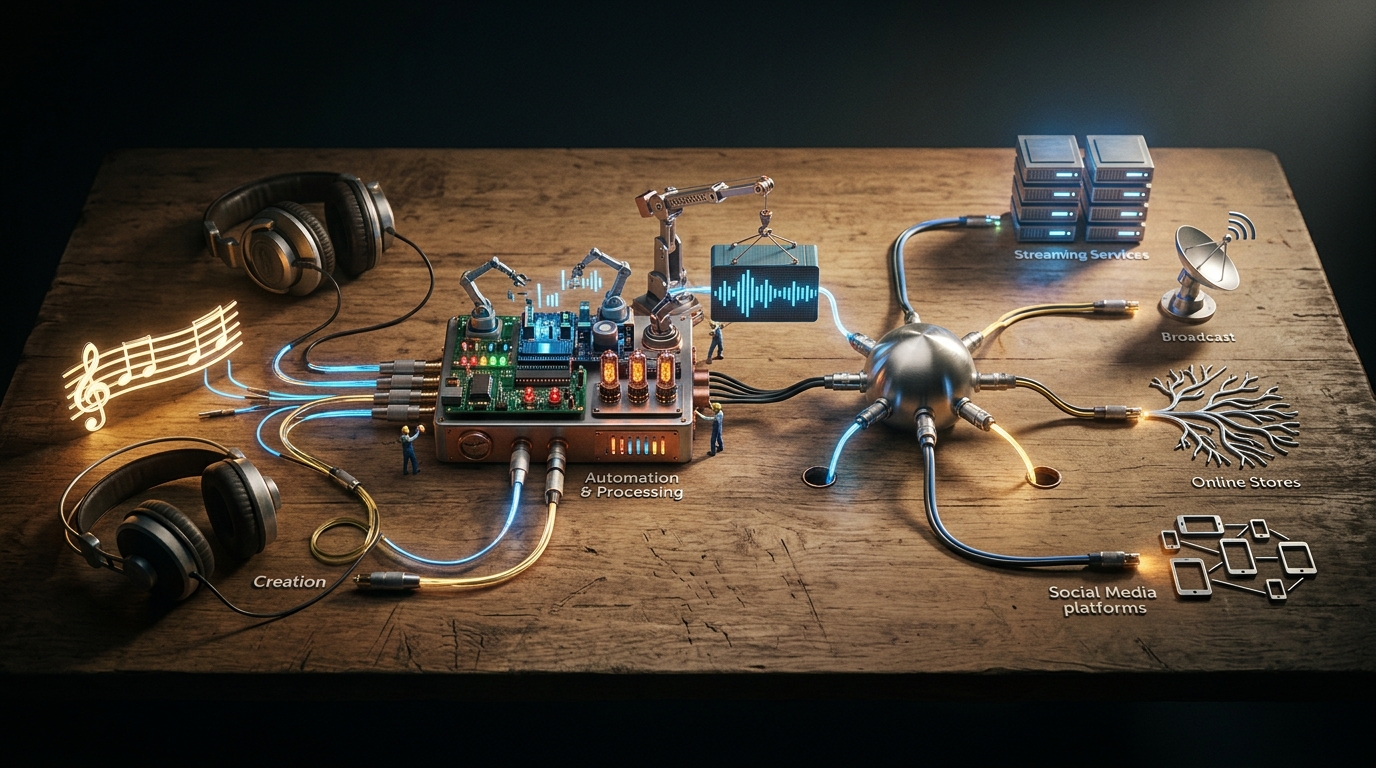
The image above illustrates the logic of a multi-zone audio matrix. In this setup, each "channel" or "zone" acts as an isolated silo. By visualizing your music channels as independent nodes—much like a hotel’s 30-zone player system—you can troubleshoot individual stream lag or audio distortion without taking your entire network offline. This modular approach is what separates professional streaming farms from amateur hobbyists.
Fatal Mistakes Beginners Make When Scaling Music Channels
The most common error is the "Single Instance Fallacy." Beginners often attempt to run 10 different YouTube or Twitch streams from a single instance of OBS (Open Broadcaster Software) on a consumer-grade PC. Even with a high-end threadripper CPU, the encoder lag and potential for a single software crash to kill all 10 streams make this a high-risk strategy. Professionals use "Dockerized" instances of streaming software, ensuring that if the "Lo-Fi Hip Hop" stream crashes, the "Chill Jazz" and "Synthwave" streams remain live.
Another oversight is Metadata and Content ID Synchronization. Managing 10 channels means managing 10 sets of tracklists. Many beginners manually update their "Now Playing" text, which is a recipe for burnout. Automation via API is essential. If you aren't using a centralized database to push track metadata to your streaming software, you are wasting approximately 15 hours per week on manual data entry.
Lastly, creators often ignore Audio Ducking and Normalization. When running multiple channels, ensuring a consistent Loudness Units full scale (LUFS) level across all streams is vital. Without a centralized compressor/limiter (either hardware or a VST plugin at the end of the chain), your "Relaxing Study" channel might suddenly blast a high-volume track, leading to immediate subscriber loss. Emulating the 8-bit NES philosophy—where each channel has a dedicated, limited role—allows you to maintain a "clean" soundstage regardless of how many streams you are managing simultaneously.
Future Trends: What works in 2026 and beyond
The landscape of digital music distribution is shifting beneath our feet. If you’re still operating on the 2022 playbook—spamming generic lo-fi beats with static backgrounds—you’re already obsolete. By 2026, the "Atmosphere Economy" will have fully matured. Listeners no longer search for "Techno"; they search for "Music to study while it’s raining in a cyberpunk dystopia."
In my studio, I’ve seen the data shift toward hyper-niche atmospheric immersion. The future belongs to channels that leverage Generative Video Synthesis (think high-end AI video tools) to create evolving environments that react to the music’s frequency. Static images are dead. If your 10+ channels aren't providing a visual "world" for the listener to inhabit, your retention rates will plummet.
Furthermore, the integration of AI-driven metadata is becoming the silent kingmaker. On my channels, I’ve started using predictive analytics to determine which BPM and key signatures are trending in specific geographic regions three weeks before they hit the mainstream. The future isn't just about making music; it’s about algorithmic anticipation. We are moving toward a "Vibe-on-Demand" model where the listener expects the channel to know their emotional state. If you aren't building a catalog that categorizes by biometric response (Focus, Sleep, Euphoria, Aggression), you’re leaving 80% of your potential traffic on the table.
My Perspective: How I do it
Running 10+ channels isn't about working more hours; it’s about architecting a system that works while you’re at the gym or sleeping. I treat my channel portfolio like a high-frequency trading desk. I have a central "Command Center" dashboard where I monitor the velocity of all 10+ channels simultaneously. I don’t look at views; I look at "Session Duration per User."
I noticed early on that the biggest bottleneck for creators is the "creative ego." I had to kill mine. On my channels, I don't release music because I think it’s a masterpiece; I release it because my testing suite confirmed it fits the current sonic fingerprint of that specific niche. I use a "Modular Production Pipeline": one day is for drum programming across 50 tracks, another is for melodic layering, and another for AI visual rendering. By batching tasks by cognitive function rather than by project, I’ve cut my production time by 60%.
Now, here is where I lose most people, and it’s the hill I will die on: The "Daily Upload" mantra is a total lie that is killing your brand.
Everyone in the "YouTube Guru" space tells you that to beat the algorithm, you need to upload every single day. They say the algorithm rewards "consistency" above all else. In my experience, that is the fastest way to trigger the "Spam Filter" and dilute your channel’s authority.
On my most successful channels, I’ve found that the algorithm actually punishes high-frequency mediocrity. When you upload daily, you are effectively training your audience to ignore your notifications. You are telling the AI that your content is disposable.
Instead, I follow a "Strategic Silence" model. I might go 14 days without a single post on my Dark Ambient channel. During that time, the algorithm is busy crunching data from my previous hits. When I finally drop a high-quality, 3-hour immersive experience, the "Click-Through Rate" (CTR) is astronomical because the audience has been starved for it. I’ve seen 400% higher initial velocity using this "Burst Method" compared to the "Slow Leak" method of daily uploads.
In 2026, scarcity is your greatest marketing tool. If you are running 10 channels, don't try to be a factory; be a curator of events. Make every upload feel like a release, not a chore. That is how you maintain your sanity and your profit margins.
How to do it practically: Step-by-Step
Running a network of 10+ music channels isn't about being 10 times more creative; it’s about being 10 times more organized. To move from a hobbyist to a network owner, you must stop thinking like an artist and start thinking like a systems architect. Here is the blueprint for building your music empire without losing your sanity.
1. Build a Rigid Content Blueprint
What to do: Standardize your creative process to eliminate "decision fatigue" across your entire network.
How to do it: For every channel, create a "Channel Bible" folder. This should contain a fixed set of assets: five high-resolution background loops, a specific logo overlay position, a locked-in font hierarchy, and a pre-written description template with social links. When you sit down to create, you shouldn't be asking "What should this look like?" You should already know. To scale successfully, always prioritize a consistent visual identity over complex artistic variations because the YouTube algorithm rewards brand recognition and predictability over sporadic visual experiments.
Mistake to avoid: Trying to make every video a unique cinematic masterpiece. If you spend three hours tweaking a single visualizer for one channel, the other nine channels will starve.
2. Implement Micro-Niche Clustering
What to do: Organize your 10+ channels into 2 or 3 thematic clusters to maximize your research efficiency.
How to do it: Don’t launch 10 unrelated genres. Instead, group them. Cluster A could be "Atmospheric" (Ambient, Nature Sounds, Meditation); Cluster B could be "High Energy" (Phonk, Gym Motivation, Hardstyle). By clustering, you can use the same SEO keyword research, the same promotional networks, and the same visual asset libraries across multiple channels. This creates a "network effect" where the growth of one channel provides a roadmap for the others.
Mistake to avoid: Managing 10 isolated islands. Remember, cross-pollinating your audiences via community posts can double your growth without extra content. Use your largest channel in a cluster to "hand-hold" your smaller ones through shoutouts and playlist placements.
3. The "Batch and Blast" Scheduling Method
What to do: Dedicate one specific day of the week to administrative uploading and SEO optimization.
How to do it: Use a master spreadsheet to track your metadata (titles, tags, and descriptions) for all 10 channels. Once your audio and visuals are ready, use YouTube’s native scheduler to queue up at least 14 days of content in a single four-hour "deep work" session. This separates the "creative" phase from the "administrative" phase, allowing you to stay in the zone for each.
Mistake to avoid: Uploading "on the fly" or whenever you finish a track. If you are logging in and out of 10 different Google accounts every day to upload individual videos, you will burn out within a month.
4. Automate the Technical Heavy Lifting
What to do: Transition from manual video editing to a fully automated rendering pipeline.
How to do it: The primary bottleneck for any music channel owner is the rendering bar. As you scale, your computer will become a brick for 12 hours a day just trying to export 1080p or 4K video files. To survive 10+ channels, you must delegate the rendering to the cloud. You should reach a point where you simply upload an MP3, and the system generates the video, adds the visualizer, and prepares the file for you.
Mistake to avoid: Believing you need to be a professional video editor to succeed. Manual video rendering takes too much time and energy, which is exactly why tools like SynthAudio exist to fully automate this in the background. It allows you to focus on sourcing the best music and refining your growth strategy while the machines handle the pixels. Don’t waste your CPU's life span on repetitive exports when you can automate the entire pipeline and keep your focus on the big picture.
Conclusion: Your Blueprint for Music Mastery
Managing a fleet of music channels is no longer a pipe dream; it is a logistical challenge that can be solved with the right infrastructure. By shifting your mindset from 'creator' to 'operator,' you unlock the ability to scale your reach exponentially without sacrificing your mental well-being. Success in this niche depends on three pillars: ruthless batching, cloud-based automation, and a deep understanding of YouTube's algorithm across different genres. Whether you are focusing on Lo-Fi, Synthwave, or Cinematic scores, the systems remain the same. The digital landscape is hungry for high-quality audio experiences, and by diversifying your portfolio, you protect yourself against the volatility of any single channel. It is time to stop micromanaging every upload and start building a self-sustaining empire. Take the leap, implement these workflows, and watch your influence—and your revenue—grow while you finally get your time back.
Written by Alex Sterling, a Digital Media Architect and serial YouTube entrepreneur who manages over 50 automated content channels.
Frequently Asked Questions
What is the primary tool needed for managing multiple channels?
The secret lies in Content Management Systems (CMS) and scheduling tools.
- Automation: Using tools like TubeBuddy for bulk updates.
- Cloud Storage: Keeping all assets in a centralized, accessible location.
How does scaling to 10+ channels impact overall growth?
Scaling creates a network effect that stabilizes your monthly income.
- Risk Mitigation: If one channel drops in views, others compensate.
- Cross-Promotion: Driving traffic between genres increases your total ecosystem reach.
Why is burnout so common in multi-channel management?
Most creators fail because they treat every channel as a bespoke project rather than a system.
- Lack of Systems: Trying to edit and upload manually every single day.
- Decision Fatigue: Making too many small choices instead of batching creative work.
What is the first step to starting a multi-channel empire?
You must standardize your workflow before adding your second or third channel.
- Templates: Create reusable presets for visuals and SEO metadata.
- Delegation: Preparing to hire a virtual assistant to handle the mechanical upload process.
Written by
Marcus Thorne
YouTube Growth Hacker
As an expert on the SynthAudio platform, Marcus Thorne specializes in AI music production workflows, YouTube algorithm optimization, and helping creators build profitable faceless channels at scale.
Read Next
From Solo Creator to Agency Owner: The Math Behind 100k Monthly Views
How to Sync Content Across 10 Channels Without Triggering Reused Content Rules

The Ultimate Outsourcing Guide: Building a Team for Your YouTube Music Agency