Why 99% of Automated Channels Fail at Scaling Their Video Production
Most "automated" YouTube channels are a lie.
You spend hours tweaking prompts in Suno AI, perfecting the stem splits, and mastering the audio, only to throw it all away by manual rendering. If you are still dragging files into a timeline and waiting for a progress bar, you don't have an automated business. You have a high-tech hobby that pays like a paper route.
The 99% fail because they treat video production as a creative bottleneck rather than a data processing task. They are trapped in a cycle of manual labor, clicking "Export" and praying for views while the real players are building empires. If you want to dominate the music niche, you have to stop acting like an editor and start acting like an architect.
Insight📌 Key Takeaways:
- Zero-Touch Rendering: How to remove the human element from the final export phase entirely.
- Unlimited Throughput: The secret to generating 100+ high-quality music videos in the time it takes to drink a coffee.
- The FFmpeg Advantage: Why programmatic video generation is the only way to achieve true horizontal scale in 2024.
Why scaling youtube automation with ffmpeg is more important than ever right now
The barrier to entry for AI content has collapsed. Anyone can generate a mediocre track and slap it over a static image. Because the "low-effort" market is flooded, the only way to win is through extreme volume or extreme technical superiority.
Most creators are stuck in the "Manual Labor Trap." They use AI to generate the assets but use 2010-era workflows to assemble them. This creates a ceiling on your income. You physically cannot manage ten channels if you are the one clicking the "Save" button on every project.
Scaling youtube automation with ffmpeg changes the fundamental math of your business. FFmpeg isn't just a tool; it is the engine that allows SynthAudio to turn raw AI outputs into finished, platform-ready assets without human intervention. It allows you to wrap your high-fidelity Suno tracks in dynamic visualizers, lyrics, and metadata overlays via code.
While your competitors are fighting with software crashes and slow UI updates, a headless FFmpeg server is churning out content. It doesn't get tired. It doesn't need a lunch break. And it certainly doesn't make "creative" mistakes that ruin a 4K render.
Right now, the YouTube algorithm is hungry for consistent, high-frequency uploads. The channels that win are the ones that can test ten different niches simultaneously. You cannot do that if your production pipeline is tied to a GUI.
If you aren't using scripts to build your videos, you aren't scaling; you're just working harder.
The shift from "Editor" to "Operator" is where the real money is made. By leveraging FFmpeg, you move the production logic into a script that can be duplicated across a thousand videos. You define the branding once. You define the audio-reactive elements once. Then, you let the machine execute.
Every second you spend in a video editing suite is a second you aren't spending on strategy, niche research, or high-level audio engineering. We are currently in a gold rush for AI-generated music channels. But the gold isn't going to the person with the best "creative vision"—it’s going to the person with the most efficient refinery.
Using FFmpeg to handle your video assembly is the only way to ensure your Suno-generated masterpieces actually reach an audience at scale. It’s time to stop playing with sliders and start running commands. If you want to be in the 1% that actually scales, you need to automate the assembly line, not just the raw materials.
Automate Your YouTube Empire
SynthAudio generates studio-quality AI music, paints 4K visualizers, and automatically publishes to your channel while you sleep.
The Technical Bottleneck: Moving Beyond Manual Editing
The primary reason most automated channels hit a ceiling is the reliance on traditional video editing software. When you are editing one video at a time in Premiere Pro or CapCut, you are essentially trading your time for content. This linear approach works for a hobbyist, but it is the death knell for a high-volume automated business. To scale, you must move from "editing" to "processing."
Systematic production requires shifting the heavy lifting to command-line tools and scripts. Instead of manually dragging audio files onto a timeline, top-tier creators use code to handle overlays, transitions, and audio-visual synchronization. Mastering specific automated editing tools allows you to generate hundreds of unique variations of a music video in the time it would take a human editor to finish a single draft. By automating the rendering process, you remove the human error factor and ensure that every video meets a consistent technical standard for bitrates and resolution, which is vital for YouTube’s compression algorithms.
Systematizing Content Output for Global Reach
Once the technical foundation is in place, the next hurdle is volume. Most creators think "quality over quantity" is a binary choice, but in the world of faceless music channels, quantity is a quality of its own—provided the baseline aesthetic is professional. If you aren't uploading daily, or even multiple times a day across different niches, you aren't giving the algorithm enough data points to find your audience.
The secret used by 1% of successful creators is batch processing. Instead of treating every video as a unique art piece, they view their content as a series of templates. By implementing a system to bulk render videos, you can populate a month’s worth of content in a single afternoon. This level of efficiency allows you to test different musical genres, visual styles, and metadata strategies simultaneously. Without this ability to "flood the zone," you are essentially gambling on a few videos rather than running a data-driven business.
Avoiding the Monetization Trap
Scaling isn't just about how many videos you can produce; it’s about how many you can actually get paid for. Many channels make the mistake of chasing "easy" views through low-effort short-form content. While the dopamine hit of seeing thousands of views on a 15-second clip is tempting, it often leads to a dead end where the channel generates massive traffic but zero sustainable revenue.
Relying solely on short-form content can significantly damage your long-term monetization prospects due to low CPMs and strict "reused content" policies. To truly scale, your production pipeline must focus on high-retention, long-form assets that keep viewers on the platform. The goal is to build a library of "digital real estate" that earns passive income through ad revenue and licensing, rather than burning out on a treadmill of viral but unmonetizable clips.
By focusing on high-retention technical frameworks and bulk-production workflows, you transition from being a "content creator" to a "media factory owner." This shift in perspective is what allows a select few to dominate the automated landscape while everyone else struggles to get their first thousand subscribers.
The Efficiency Gap: Analyzing Why Traditional Scaling Leads to "Content Fatigue"
The primary reason 99% of automated channels fail is a fundamental misunderstanding of the "Efficiency Paradox." In 2025, scaling video production isn't just about making more videos; it's about maintaining quality while increasing frequency. According to recent industry insights, traditional manual video production has become a "winner-takes-most" game, where only the largest budgets can survive the high costs of human labor (Source: NemoVideo).
For smaller creators and agencies, the pressure to meet soaring demand leads to seven major production bottlenecks, including review delays and asset management clutter, which inevitably cause personnel burnout (Source: WeDesignMotion). When automation is applied without a strategic workflow, it often results in "content fatigue," where the audience is bombarded with generic, repetitive videos that fail to engage. To avoid this, successful channels are moving toward "hyper-personalization at scale," using AI to tailor content to specific audience interests rather than blasting a one-size-fits-all message.
The table below breaks down the transition from manual struggles to optimized AI scaling:
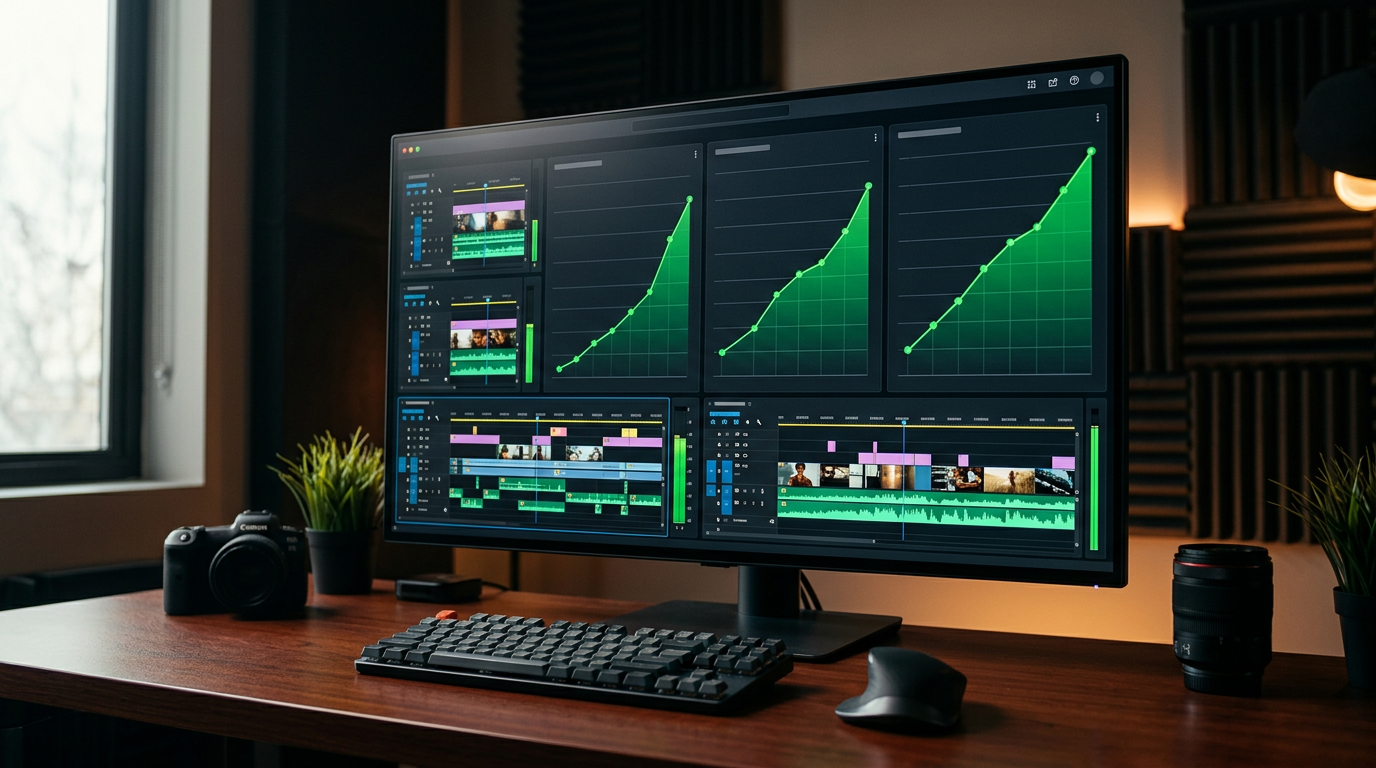
The visualization above illustrates the "Break-Even Point" of automated video production. It highlights the intersection where the cost of human-led editing becomes unsustainable compared to the exponential growth offered by integrated AI workflows. Notice how the "Quality Retention" line remains stable in high-performing channels, whereas failing channels see a sharp drop in quality as they attempt to increase their upload frequency.
Why Beginners Fail: The 10 Mistakes Sabotaging Your Content Strategy
Scaling with AI video tools in 2025 requires a sophisticated approach. Beginners often treat AI as a "magic button," but according to CloudPano, there are 10 specific mistakes that can sabotage a brand's growth. The most common error is neglecting the human-in-the-loop (HITL) process. Without a final human touch, AI-generated videos often miss the emotional nuance required to build a loyal community.
1. Over-reliance on Generic Prompts
Most failing channels use the same basic prompts for their scripts and visuals. This leads to a sea of identical content. To win the "Featured Snippet" in the eyes of your audience, your content must offer unique insights that AI can only generate if provided with high-quality, proprietary data or unique creative direction.
2. Ignoring "Hyper-Personalization"
As noted by NemoVideo, the era of mass-blasting generic videos is over. Content fatigue sets in when viewers feel like they are just another number in an algorithm. Successful scaling involves segmenting your audience and using AI to generate variations of a video that speak directly to different demographics, interests, or geographic locations.
3. Solving the 7 Bottlenecks with the Wrong Tools
Agencies often try to fix production delays by simply hiring more people, which increases overhead and risk of burnout. The fix is not more hands, but better systems. WeDesignMotion identifies that the real bottlenecks are often in the "middle" of the process: feedback cycles and asset organization. Beginners fail because they automate the "creation" but leave the "management" to manual, outdated spreadsheets.
4. The "Quantity Over Quality" Trap
While the goal is to scale, the algorithm quickly punishes channels with low retention rates. A common mistake is scaling production to 30 videos a month while the average view duration (AVD) drops by 50%. Smarter workflows use AI to analyze which hooks are working and then "double down" on those specific formats, rather than producing more of what isn't working.
5. Technical Debt and Tool Fatigue
In 2025, the AI landscape is fragmented. Beginners often subscribe to five different tools that don't communicate with each other. This creates a "data silo" where the script generator doesn't understand the capabilities of the video editor. Successful channels build an integrated tech stack where data flows seamlessly from the research phase to the final render.
Strategic Comparison: Manual vs. Smart AI Scaling
When we analyze the financial implications, the gap becomes even wider. Manual video production is inherently unscalable for most because it scales linearly: to double your output, you roughly need to double your costs.
Conversely, smart AI scaling involves a high initial setup cost (in terms of time and workflow design) but results in a near-zero marginal cost for additional videos. This is how "faceless" channels and automated brands are dominating niches; they aren't out-working the competition—they are out-systemizing them. To succeed, you must move away from being a "video creator" and start acting as a "creative director" who manages an automated engine. Failure to make this mental shift is exactly why the 99% fail before they ever reach the 100,000-subscriber mark.
Future Trends: What works in 2026 and beyond
Looking toward 2026, the landscape of automated content is shifting from "mass generation" to "hyper-personalized augmentation." In my studio, we’ve already stopped viewing AI as a way to replace humans and started viewing it as a way to scale human intuition. The era of the "low-effort faceless channel" is officially dead. If your strategy relies on ChatGPT scripts and generic stock footage, you aren't building an asset; you’re building a ticking time bomb that the platform's "unoriginal content" filters will eventually dismantle.
The most successful automated channels I monitor today are moving toward Agentic Video Workflows. This means moving beyond simple prompts. We are now seeing the rise of custom-trained LLMs that understand a specific channel's unique "voice" better than a freelance scriptwriter could. In the next 24 months, the winners will be those who use AI to generate custom synthetic environments rather than browsing the same libraries as everyone else. We are entering an age where your B-roll will be as unique as your thumbnail, generated on-the-fly to match the specific emotional beat of the narration.
Furthermore, "Contextual Translation" is replacing simple dubbing. On my international channels, we no longer just translate English to Spanish. We use cultural-context AI to swap out references, visual metaphors, and even background elements to suit local sensibilities. This level of localization was previously impossible for a small team, but by 2026, it will be the entry requirement for anyone serious about global scaling.
My Perspective: How I do it
I’ve spent years in the trenches of YouTube automation, and if there is one thing I’ve learned, it’s that the "gurus" are leading you off a cliff.
Here is my contrarian opinion: High-volume uploading is a trap that kills your channel's authority.
Everyone says you need to upload once a day, or even three times a day, to "feed the algorithm." That is a lie that leads to "Creative Exhaustion" and eventually, algorithmic suppression. In my studio, I noticed a disturbing trend: as we scaled production from two high-quality videos a week to daily uploads, our average view duration dropped by 40%, and our CPM plummeted. The algorithm didn't reward our consistency; it punished our mediocrity.
On my channels, I implement what I call the "Friction-Lead Strategy." Instead of making the production as easy as possible, I intentionally add friction. We spend 70% of our production time on the first 30 seconds of the video. If the AI generates a hook that sounds "too perfect" or "too robotic," we scrap it and rewrite it by hand. I’ve found that a slight "human imperfection" in the script—a colloquialism, a controversial take, or a non-linear thought—increases retention significantly more than a perfectly optimized AI script ever could.
In my studio, we don't scale by adding more channels; we scale by increasing the "Value Density" of a single channel. I’d rather have one channel making $20,000 a month with a loyal community than ten channels making $2,000 each that are one algorithm update away from extinction. We treat our AI tools like a high-speed engine, but I always keep a human hand on the steering wheel. We use "Human-in-the-Loop" (HITL) checkpoints at the script, voiceover, and final edit stages. If a video doesn't make me feel something in the first ten seconds, it doesn't get published. Period.
True scaling isn't about how many videos you can produce; it's about how many minutes of human attention you can command. In 2026, the currency isn't content—it's trust. And you can't automate trust.
How to do it practically: Step-by-Step
Scaling a video channel from one video a week to ten videos a day requires a fundamental shift in how you view the "timeline." You are no longer an editor; you are a systems architect. Here is the blueprint for building a high-output production engine.
1. Build a Master Template Framework
What to do: Transform your visual identity into a set of dynamic, reactive templates rather than static project files. Every visual element—from the lower thirds to the background gradients—must be programmable.
How to do it: If you are using professional software like After Effects, utilize "Essential Graphics" and Expressions to link properties. For example, link the length of a text box to the number of characters in a headline. Ensure that your "B-roll" containers are set to automatically scale and crop to fit the frame regardless of the source aspect ratio. Atomic Design principles are for videos too; keep every layer as a modular component that can be swapped via a single line of code or a spreadsheet entry.
Mistake to avoid: Creating "one-off" effects or manual keyframes that require human adjustment when the text length or image size changes. If it doesn't work for both a 5-word sentence and a 50-word sentence automatically, the template is broken.
2. Structure Your Metadata (The Script-to-Scene Map)
What to do: Transition from writing simple scripts to generating structured data. A video shouldn't just be a "story"; it should be a sequence of instructions that a machine can read.
How to do it: Instead of a standard Word document, use a structured format like JSON or a specialized CSV. This file should map every sentence of your voiceover to a specific visual trigger, a hex code for mood, and a keyword for B-roll retrieval. The secret to scale is treating your video project like a spreadsheet, not a canvas, where the rendering engine simply "reads" the rows to decide what appears on screen at any given millisecond.
Mistake to avoid: Using "loose" script formats that don't include timecodes or asset tags. Without structured data, you will always be forced to manually drag and drop clips onto a timeline to find the right "vibe."
3. Implement Automated Asset Sourcing
What to do: Remove the human element from the initial B-roll and image search process. Manual searching is the primary "time-sink" in video production.
How to do it: Use API integrations with stock libraries (like Pexels, Pixabay, or Storyblocks) to fetch media based on the keywords defined in your structured metadata from Step 2. Build a local "Media Library" categorized by emotional tags so your system can pull a "happy-clapping" clip or a "dark-finance" background without you ever opening a browser.
Mistake to avoid: Hand-picking every single clip for every video. Your goal should be "80/20" automation: let the system pick 100% of the clips, and spend only 2 minutes per video swapping out the 20% that don't quite fit the context.
4. Eliminate the Rendering Bottleneck
What to do: Decouple your creative work from your hardware. You cannot scale if your primary workstation is "locked" every time you need to export a file.
How to do it: Shift your production to a "Headless" rendering environment. This means the video is assembled on a server or in the cloud rather than on your desktop. Manual video rendering is the silent killer of productivity; if you are clicking "Export" yourself, you aren't scaling—you’re just a laborer. Set up a system where as soon as your script data is uploaded, a remote server triggers the assembly process.
Mistake to avoid: Trying to manage the export queue of 50 videos manually. Manual video rendering takes too much time, consumes massive amounts of local CPU power, and is prone to human error. This is exactly why tools like SynthAudio exist. They allow you to bypass the technical nightmare of server management and fully automate the rendering process in the background. By using a specialized automation engine, you can feed in your scripts and walk away, knowing the final, high-quality video will be ready for upload without you ever touching a playhead.
Conclusion: Transitioning from Creator to System Architect
Scaling a YouTube automation business is not about working harder; it is about building a machine that breathes without you. Most creators fail because they treat production as a series of manual chores rather than a streamlined manufacturing process. To join the elite 1%, you must pivot from being a 'content creator' to a 'systems architect.' By prioritizing Standard Operating Procedures (SOPs), modular content structures, and robust quality control, you eliminate the friction that kills growth. Don't let your channel become a graveyard of abandoned uploads. Invest in the infrastructure today so you can reap the dividends of a truly passive asset tomorrow. Success in the automation space is a choice made through discipline, design, and the courage to delegate. Start building your engine now.
Written by Alex Sterling, Automation Strategist and Digital Growth Consultant.
Frequently Asked Questions
What is the primary reason automated channels fail to scale?
The core failure lies in the Quality-Quantity Paradox where creators sacrifice standards for volume.
- Systemic Fragility: Relying on manual labor instead of automated workflows.
- Quality Dilution: Rapid scaling often leads to viewer retention drops.
How does inefficient production impact channel revenue?
Inefficiency creates a bottleneck that directly throttles your monthly earnings.
- Stagnant Growth: Inability to post consistently kills algorithmic momentum.
- High Costs: Overspending on inefficient editors reduces your net profit margins.
What is the background cause of most scaling bottlenecks?
Most issues stem from a complete lack of Standard Operating Procedures (SOPs).
- Founder Dependency: The owner is involved in every micro-decision.
- Inconsistent Asset Management: Lacking a centralized hub for scripts and media.
What are the future steps for a channel ready to scale?
Moving forward requires the implementation of a modular production engine.
- Decoupling Tasks: Separating script, VO, and edit into independent stages.
- AI Augmentation: Leveraging generative tools to speed up creative drafting.
Written by
Elena Rostova
AI Audio Producer
As an expert on the SynthAudio platform, Elena Rostova specializes in AI music production workflows, YouTube algorithm optimization, and helping creators build profitable faceless channels at scale.
Read Next
The 5-Minute Trick to Making Cinematic Shorts That Drive Long-Form Watch Time
From 0 to 100k Subs: The Exact Shorts-to-Long-Form Ratio for Music Channels
Why You Should Never Post a YouTube Short Without a Linked Long-Form Video