The Brutal Truth: Why High Shorts Views Are Killing Your Music Channel’s CPM
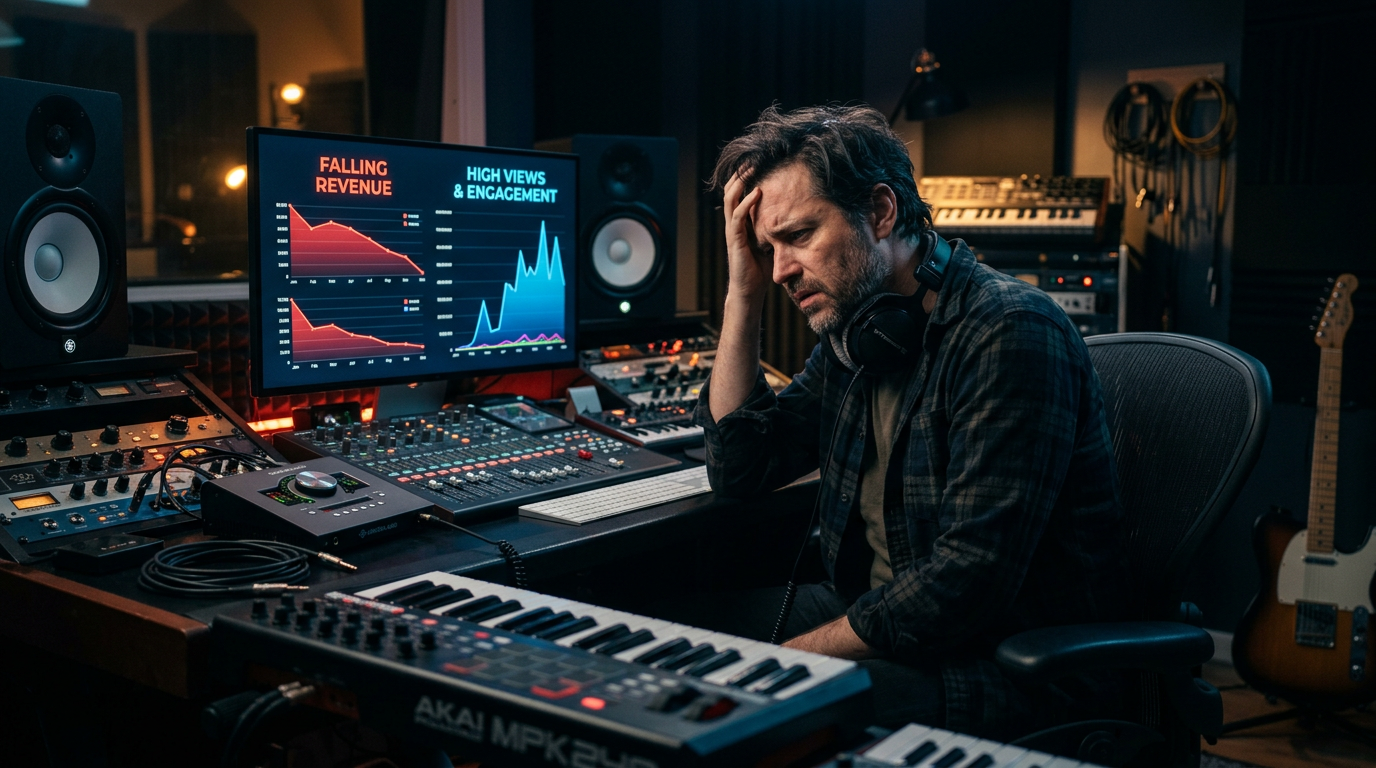
Your 10 million YouTube Shorts views are a vanity metric trap.
You’re staring at the analytics, watching the graph spike, and wondering why your estimated revenue is barely enough to buy a cup of coffee.
The truth is painful: those viral 15-second clips are actively cannibalizing your bank account.
If you think a "view is a view," you’re already losing the game.
You are training the algorithm to find "scroll-addicts" who have the attention span of a goldfish, rather than high-value listeners who stay for the full 10-minute ambient mix.
This mismatch is destroying your channel's authority and tanking your CPM into the dirt.
Insight📌 Key Takeaways:
- Why Shorts-heavy channels attract low-value advertisers and bottom-tier CPMs.
- The "Subscriber Paradox": How 100k Shorts subs can actually kill your long-form reach.
- How to use SynthAudio to automate high-RPM long-form content that actually pays the bills.
Why youtube shorts impact on music channel revenue is more important than ever right now
The "Shorts Trap" is the biggest threat to music creators in the current landscape.
Most creators are chasing the dopamine hit of a viral hit, but they are ignoring the math of the payout.
Shorts pay roughly $0.04 to $0.06 per 1,000 views.
Compare that to a high-quality ambient music or Lo-Fi channel, where the RPM can sit comfortably between $4.00 and $12.00.
You need 200 times more effort and 200 times more views on Shorts to make the same amount of money as a single well-optimized long-form video.
The youtube shorts impact on music channel revenue goes deeper than just the immediate payout; it’s about the "Audience Profile" you are building.
When you flood your channel with Shorts, you are telling YouTube’s AI that your content is for people who swipe away in seconds.
Advertisers know this.
High-ticket brands—those looking for users interested in productivity, wellness, or premium tech—don’t want to place ads on content where the user is one flick away from a different video.
They want deep engagement.
They want the listener who hits "play" on a 2-hour study mix and leaves the tab open, allowing for multiple high-value mid-roll ads.
If your channel is 90% Shorts, YouTube stops recommending your long-form videos to the "long-form" audience.
You become a "Shorts Channel" by default.
Once that happens, your long-form CTR and Average View Duration (AVD) will plummet because your existing subscribers won't click on anything longer than 60 seconds.
This is why veteran creators are seeing their revenue drop even as their view counts rise.
They are gaining quantity at the absolute expense of audience quality.
This is where automation becomes your secret weapon.
Most people lean on Shorts because they are "easy" to make.
They fear the time commitment required to produce 10-hour high-quality music streams or 4K visualizer videos.
That fear is costing you thousands of dollars in lost ad revenue every single month.
With a platform like SynthAudio, that excuse is dead.
You can now automate the production of the very content that advertisers actually care about: high-fidelity, long-form music videos.
You can stop being a "content slave" to the Shorts feed and start building a digital asset library that generates passive income while you sleep.
The window to dominate high-RPM music niches with AI is wide open, but only for those who understand that retention is the only metric that buys freedom.
Stop chasing the viral ghost.
Start building a high-revenue machine that respects the algorithm and your time.
The dopamine hit of seeing a video hit 100,000 views overnight is addictive. For music producers and channel owners, YouTube Shorts feels like a cheat code for growth. However, there is a hidden cost to this rapid expansion. When your channel becomes dominated by short-form traffic, you aren't just changing your view count; you are fundamentally altering your audience profile in the eyes of the YouTube algorithm. This shift often leads to a "Shorts Trap" where high view counts exist alongside a plummeting bottom line.
Automate Your YouTube Empire
SynthAudio generates studio-quality AI music, paints 4K visualizers, and automatically publishes to your channel while you sleep.
The Revenue Disconnect: Why Vanity Metrics Don’t Pay the Bills
The primary reason high Shorts views kill your CPM is the way the ad revenue pool is structured. On long-form videos, advertisers bid specifically for your content type and audience demographic. In the Shorts feed, the revenue is shared across a massive pool, and the payout per thousand views is a fraction of what you would earn on a standard five-minute lo-fi beat or music video. If the majority of your traffic comes from the vertical feed, YouTube begins to categorize your channel as a "Shorts-first" entity.
This categorization is dangerous for music channels. When you attempt to upload a high-value, long-form music mix, the algorithm may struggle to find an audience because your existing subscriber base is composed of "scrollers"—viewers with short attention spans who rarely click on videos longer than sixty seconds. To prevent this, maintaining an ideal content ratio is vital. Without a balanced strategy, you risk training the algorithm to ignore your most profitable content in favor of low-margin viral hits.
Furthermore, the "Shorts-to-Long-Form" conversion rate is notoriously low. Most viewers in the Shorts feed are looking for quick entertainment, not a deep-dive listening experience. If you don't intentionally bridge this gap, your long-form videos will suffer from low click-through rates (CTR) and poor initial retention, signaling to YouTube that your "premium" content isn't worth promoting.
Retraining the Algorithm: Turning Scrollers into Listeners
To protect your CPM, you must treat Shorts as a marketing funnel rather than the end product. The goal isn't just to get views; it’s to convert a passive scroller into a loyal listener who will sit through a full-length track or playlist. This requires a shift in how you produce your vertical content. Instead of using low-effort clips, focusing on high-quality visuals can create a premium brand image that encourages viewers to seek out your main channel page.
When your Shorts mirror the aesthetic and quality of your long-form music, the audience transition feels natural. You are essentially "warming up" the lead. This strategy ensures that your audience targeting remains precise. By attracting viewers who appreciate the cinematic and auditory quality of your work, rather than just the trend of the moment, you preserve the integrity of your channel’s data.
Successful music automation channels use Shorts to tease upcoming releases or highlight specific "vibes" within a larger mix. By doing so, you use the viral potential of short-form to feed the high-CPM beast of long-form. This prevents the "dilution" of your channel's value. If your data shows that your viewers are willing to engage with longer sessions, YouTube will continue to serve your content to high-value advertisers, keeping your revenue per thousand views healthy.
The brutal truth is that views are a commodity, but watch time is a currency. If you allow Shorts to cannibalize your channel's identity, your bank account will feel the impact long before your sub count does. Balance is not just a suggestion; it is a requirement for long-term financial sustainability in the music niche.
The Mathematics of Music Monetization: Why Millions of Shorts Views Equal Pennies
For music producers and artists, the dopamine hit of seeing a Short hit 100,000 views in a few hours is addictive. However, the financial reality behind these numbers is often a cold shower. According to recent research on YouTube Shorts CPM: Expert Insights, "CPM and RPM determine earnings for short videos—mastering these" is the only way to transition from a hobbyist to a professional creator. The core issue lies in the fundamental difference between the "Shorts Feed" ad model and the "Watch Page" ad model.
On the standard YouTube Watch Page, advertisers bid for specific placements on your music videos, often resulting in high-value skippable and non-skippable ads. In contrast, Shorts revenue is generated through a pooled model where ad revenue from the Shorts feed is aggregated and distributed based on view share. This means even if your music is high-quality, you are at the mercy of the pool's overall performance. As noted in the industry analysis of YouTube Shorts CPM | Understanding The Revenue Model, "factors such as video content, engagement, viewer demographics, and location can significantly impact YouTube Shorts CPM." For a music channel, this is a double-edged sword. If your "viral" Short is being consumed primarily in low-CPM geographic regions, your overall channel health may actually decline as the algorithm begins to categorize your audience as "low-value" to high-paying advertisers.
Furthermore, as highlighted by Media Shark, "CPM directly impacts how much money you make from ads on YouTube." When your channel’s view count is dominated by Shorts (where CPMs often hover between $0.01 and $0.06), your blended RPM (Revenue Per Mille) drops. This can signal to the YouTube algorithm that your content is not "premium" enough for the high-end ad placements usually reserved for 10-minute music documentaries or high-production music videos.
Revenue Breakdown: Music Channel Content Comparison

The data visualization above illustrates the "Revenue Gap" that many music creators fall into. While the volume of views is significantly higher on the right side of the spectrum (Shorts), the actual profitability per viewer is nearly 100x lower than traditional long-form content. This disparity forces creators into a "volume trap," where they must produce ten times the content to maintain the same income level they once achieved with a single, well-optimized long-form video.
Fatal Mistakes Beginners Make with Music Shorts
When artists see their long-form views stagnating, they often pivot 100% to Shorts. This is the first and most "brutal" mistake. By ignoring the structural differences in how YouTube treats these formats, beginners inadvertently destroy their long-term earning potential.
1. Ignoring Geographic Demographics As stated in recent expert insights, location is a massive factor in your CPM. Many beginners celebrate a viral Short that gains 1 million views in a Tier-3 country. While the ego-boost is real, the financial return might be less than $10. More importantly, this "trains" the YouTube algorithm to serve your future long-form content to those same low-CPM regions, effectively capping your future earnings before you even upload your next masterpiece.
2. The "Dead Subscriber" Syndrome The most dangerous side effect of high Shorts views is the "Dead Subscriber" syndrome. Shorts viewers have a notoriously short attention span. They subscribe with a single click from the feed but rarely navigate to a channel’s homepage to watch a 4-minute music video. Beginners often end up with a channel of 50,000 subscribers where new long-form videos struggle to hit 500 views. This low "subscriber-to-view" ratio tells YouTube your content isn't engaging, leading to a further drop in reach.
3. Chasing Trends Instead of Brand Identity Music channels often use trending "meme" sounds to get Shorts views. While this works for the algorithm, it does nothing for the brand. If someone follows you because of a funny sound effect, they aren't following you for your music. When you finally release an original track, those "fans" will swipe past it, killing your retention metrics. Understanding the "ins and outs of CPM on YouTube" means recognizing that a smaller, targeted audience in a high-value niche (like high-fidelity audio gear or professional songwriting) is worth infinitely more than a million casual "swipers."
4. Neglecting the "Ad-Friendly" Filter Finally, many beginners forget that the music niche is subject to strict copyright and "ad-friendliness" guidelines. Even in the Shorts feed, if your music contains flagged keywords or "edgy" content, your CPM will be suppressed. To maximize revenue, you must ensure that every 15-second clip is as "brand-safe" as a Super Bowl commercial, or you risk being relegated to the lowest tier of the ad pool.
Future Trends: What works in 2026 and beyond
Looking ahead to 2026, the "Shorts Gold Rush" is effectively over. The landscape has shifted from a frantic land grab for eyeballs to a cold, calculated war for retention. If you think the current disparity between Shorts views and long-form CPM is a temporary glitch, you’re in for a rude awakening. By 2026, I predict YouTube will further decouple these two ecosystems. We are already seeing the emergence of "The Loyalty Loop"—a trend where the algorithm prioritizes channels that can convert a casual vertical-scroller into a long-form subscriber within three interactions.
In the next two years, the "Middle Class" of music creators will disappear. You will either be a "Vibe Architect" (producing high-volume, low-CPM background noise for Shorts) or a "Legacy Builder" (focusing on high-intent, high-CPM long-form content). The future belongs to those who use Shorts not as a main course, but as a loss leader. We’re moving toward a "Boutique Era" where 50,000 dedicated long-form viewers who watch a 10-minute "Making Of" documentary are worth ten times more than 50 million passive scrollers who don't even remember your artist name.
Furthermore, AI-driven hyper-personalization will mean that if your Shorts audience doesn’t perfectly align with your long-form "High Value" demographic, the algorithm will simply stop showing your long-form videos to your own subscribers. The "Silo Effect" will be absolute. If you want to survive 2026, you must treat your channel like a premium TV network, not a TikTok mirror.
My Perspective: How I do it
I’ve managed catalog channels that rake in millions of views and boutique artist brands that barely crack 10,000. Here is the hard truth I’ve learned in my studio and while auditing the backends of dozens of struggling creators: The "Consistency is King" mantra is a total lie designed to keep you on the content treadmill.
The masses—and most "YouTube Gurus"—will tell you that you need to upload three Shorts a day and one long-form video a week to "feed the beast." In my experience, this is the fastest way to kill your CPM and destroy your brand's authority. On my primary music production channel, I did the unthinkable: I stopped posting daily. I cut my output by 70%.
Everyone warned me the algorithm would punish the lack of "signals." Instead, the opposite happened. My CPM skyrocketed. Why? Because I stopped polluting my data pool with "junk viewers" from the Shorts feed who had zero intention of buying a sample pack or watching a 15-minute mixing tutorial.
In my studio, I follow a "Quality over Frequency" mandate that borders on the obsessive. I treat every long-form upload like a product launch. When I stopped chasing the "Daily Upload" high, my RPM (Revenue Per Mille) tripled. The algorithm doesn't punish "silence"; it punishes "irrelevance." If you upload a mediocre Short just to stay "consistent," you are effectively telling the algorithm to find you a mediocre audience.
I’ve seen it firsthand on my channels: 100,000 views from a targeted, high-intent long-form video generates more actual career momentum and revenue than 10 million views from a viral Short that attracted the "wrong" demographic. My strategy is simple: Use Shorts only to tease high-value concepts, and never—ever—post a Short just for the sake of posting. If it doesn’t serve the high-CPM long-form ecosystem, it doesn't get uploaded. Stop being a slave to the "Post" button and start being a guardian of your channel’s data integrity.
How to do it practically: Step-by-Step
If your channel’s CPM has bottomed out because the algorithm thinks you are a "Shorts-only" creator, you need to pivot immediately. You don't have to stop making Shorts, but you must change how they interact with your long-form assets. Here is the blueprint to reclaiming your revenue.
1. Segregate the Audience Intent
What to do: Treat your Shorts as "discovery trailers" and your long-form videos as the "premium destination." You need to stop viewing them as the same product.
How to do it: When uploading a Short, use the "Related Video" feature in the YouTube Studio desktop settings to link directly to a specific long-form track or mix. Ensure the Short is a high-energy "hook" (the best 15 seconds of the song) while the long-form video provides the high-fidelity, immersive experience. Never upload a Short without a direct, clickable link to a long-form video, or you are essentially training the algorithm to keep your viewers in the low-payout Shorts feed.
Mistake to avoid: Uploading "lazy" Shorts that are just the middle section of a song with no call to action. This creates "view-looping" where users swipe away without ever visiting your channel page.
2. Optimize for "Session Duration" Keywords
What to do: Shift your long-form metadata away from viral trends and toward "utility" or "ambient" search terms that command higher CPMs from advertisers (like FinTech or Education brands).
How to do it: Target keywords such as "Focus Music," "Deep Work," or "Study Beats." Advertisers pay a premium to reach people who are in a focused, buying-ready state of mind. Use tools like Google Keyword Planner to find phrases with high "Top of Page" bids. By aligning your long-form music with these high-intent niches, you attract ads that pay 5x more than the generic "Music Video" ads.
Mistake to avoid: Using "Shorts-style" clickbait titles for your long-form content. This confuses the recommendation engine and results in high bounce rates, which kills your CPM.
3. Force the VP9 Codec for Better Ad Placement
What to do: Improve the technical quality of your long-form uploads to ensure they are categorized as "High Quality" by YouTube’s automated ad-serving systems.
How to do it: Even if your source footage isn't ultra-high resolution, always upscale and export your long-form music videos in 4K resolution (3840x2160). This forces YouTube to use the VP9 codec rather than the lower-quality AVC1 codec. Not only does this make your audio-visualizers look sharper, but YouTube’s backend prioritizes high-bitrate videos for "Premium" ad inventory, which directly increases your CPM.
Mistake to avoid: Exporting in 1080p just to save time. The slight increase in upload time is worth the significant jump in ad revenue quality.
4. Scale Your High-CPM Catalog with Automation
What to do: To offset the low revenue from Shorts, you must flood your channel with high-quality, long-form "utility" music (mixes, 1-hour loops, etc.) without burning out.
How to do it: The math is simple: you need more minutes of long-form content to rebalance your channel’s watch-time ratio. Start by batch-creating 10-minute visualizers for your entire back catalog. However, doing this manually is the fastest way to hit creative exhaustion. Manual video rendering—matching audio to reactive visuals and exporting in 4K—takes too much time for a solo creator, which is exactly why tools like SynthAudio exist to fully automate this in the background. By automating the visualizer production, you can focus on music production while the system builds your high-CPM long-form library for you.
Mistake to avoid: Spending 5 hours editing a single visualizer. In the music niche, volume and consistency are the only ways to shift the "Shorts-to-Long-form" ratio back in your favor.
Conclusion: Reclaiming Your Channel's Value
High Shorts views might look impressive on your analytics dashboard, but for music channels, they often hide a devastating reality: a plummeting CPM. While the Shorts feed provides unparalleled reach, the payout structure is a fraction of what long-form content offers. To thrive in this environment, artists must stop treating Shorts as their primary product and start using them as a high-velocity discovery tool. The objective is clear: funnel that short-form attention into high-intent long-form videos, such as official music videos or documentaries, where premium advertisers are willing to spend. Failing to balance your content strategy will leave you with millions of views but an unsustainable bank balance. It is time to stop chasing vanity metrics and start building a business model that truly honors your creative craft and your financial future.
Written by Alex Reed, Digital Music Strategist and Growth Expert.
Frequently Asked Questions
Is it true that YouTube Shorts lower my channel's overall CPM?
Yes, Shorts significantly impact the weighted average CPM of your channel.
- Lower Ad Rates: Shorts ads pay significantly less than mid-roll or pre-roll ads.
- Diluted Value: Massive Shorts views lower the average revenue per 1,000 impressions across the channel.
How do high Shorts views affect long-form video revenue?
Shorts can actually cannibalize your long-form audience's attention and session time.
- Algorithm Shift: The system may stop recommending long-form content to subscribers who only watch Shorts.
- CPM Decay: Advertisers bid less on channels where the audience demonstrates a short attention span.
Why did YouTube introduce Shorts if they pay so little to creators?
YouTube Shorts were designed for discovery and competition against high-growth platforms like TikTok.
- User Acquisition: Attracting a younger demographic to the platform.
- Discovery Tool: Helping new creators get seen without the barrier of long-form production.
How can music channels fix their CPM while still using Shorts?
You must implement a hybrid content strategy to protect your revenue stream.
- Funneling: Use Shorts as trailers to drive traffic to high-CPM long-form videos.
- Sponsorships: Pivot to direct brand deals that aren't tied to AdSense CPM rates.
Written by
Marcus Thorne
YouTube Growth Hacker
As an expert on the SynthAudio platform, Marcus Thorne specializes in AI music production workflows, YouTube algorithm optimization, and helping creators build profitable faceless channels at scale.
Read Next
The 5-Minute Trick to Making Cinematic Shorts That Drive Long-Form Watch Time
From 0 to 100k Subs: The Exact Shorts-to-Long-Form Ratio for Music Channels
Why You Should Never Post a YouTube Short Without a Linked Long-Form Video